As New Jersey and Philadelphia nursing home abuse lawyers, we have been randomly viewing the New Jersey Department of Health and Senior Services report cards for New Jersey nursing home. The State of New Jersey publishes these reports for each nursing home and long term residential facility in New Jersey. We have been reviewing the inspection summary reports for different nursing homes and reporting on those that have a large number of citations. It is important to review these reports to be aware of any signs of possible nursing home abuse.
Sterling Manor in Maple Shade, NJ
 Today we are posting on Sterling Manor. Sterling Manor is a nursing home that has 124 long term patient beds under its care. It is located in Maple Shade, New Jersey in Burlington County. Sterling Manor had 3 routine inspections over the two year period from November 2008 until October 2010. It also had 14 complaint inspections during that same time period. The Sterling Manor nursing home was cited for physician visit issues relating to care/notes/orders etc., as well as residential record issues, life safety code violations, and bed sores. (As we have posted on many occasions, bed sores, themselves, are signs or nursing home abuse.)
Problems relating to the treatment and prevention of bed sores is also one of the reasons the facility received a complaint inspection as recently as July 2010. Another complaint inspection occurred due to food sanitation and preparation issues. These types of issues are what can lead to claims of nursing home abuse. It is important if you plan on having your loved one cared for in any nursing home, including Sterling Manor in Maple Shade, that you review these State of New Jersey Licensing and Evaluation inspections, to make sure it is a safe environment free from abuse.
Nursing Home Abuse Lawyers in New Jersey and Philadelphia
If your loved one is a resident at a nursing home and you believe that the care they are receiving may be negligent or abusive, contact the Mininno Law Office for a free case evaluation. You may also call for a free consultation at (856) 833-0600 in New Jersey, or (215) 567-2380 in Philadelphia. Our team can work to earn you the compensation you deserve.
 Today’s post takes a look at a nursing home facility in Gloucester County. The name of the facility is Manorcare Health Services. It is located on West Deptford and has 156 long term care beds.
  Today we are reporting about the South Jersey Health Care Center located in Camden, New Jersey. This is a nursing home that has 120 long term care patient beds. In a two year period, from November 2008 until October 2010, this nursing home was inspected on two separate occasions. During those inspections, the nursing home was cited for 16 separate violations. These violations included failure to meet proper safety code standards, lack of proper housekeeping and maintenance services, and food and nutritional issues. Many of the violations were found to occur often, and at least one of the violations was considered immediate jeopardy to residents’ health and safety.
 Today, we are reporting on the Stratford Nursing & Convalescent Center located in Stratford, New Jersey. The latest published report shows all of the violations found during the routine inspections for the two year period between November 2008 and October 2010. The Stratford Nursing & Convalescent Center had 33 cited nursing home violations on the two combined inspection dates. The facility’s citations included safety code violations, life safety code standard violations, and others related to abuse and neglect. The level of violations were mainly rated as being pattern or widespread violations, with at least four considered to cause immediate jeopardy to the residents health or safety. Stratford’s ratings are a sure cause for concern, and it is quite clear that immediate corrective action needs to be taken. The facility’s noncompliance with one or more standards has caused, or is likely to cause, serious injury, harm, impairment, or death to a patient or resident.
  As a family member of a nursing home resident, it is important to be aware of the signs and symptoms of nursing home neglect and abuse. Keep a close watch not only on your loved one, but on the facility in it’s entirety, for the following signs of neglect:
 It is important that nursing home staff be fully trained in how to deal with the special needs of nursing home patients so that physical abuse does not occur. It is also important that a patient’s family be aware of the signs of abuse. Some of the more obvious signs are bruising, cuts, unexplained marks, broken bones, and a variety of injuries in various stages of healing. It is also important to listen to the patient. A resident’s report of violent behavior, such as being hit or mistreated, must be investigated. Sometimes, a nursing home patient’s sudden change in behavior can be a sign of nursing home abuse or neglect and should absolutely be investigated.
  One way to prevent bed sores from forming is to have a staff that is properly educated. Educational programs about bed sore and pressure ulcer prevention should be made mandatory for all levels of health care providers. They should also be made available for patient families so that they can make sure nursing home staff members are giving their loved ones the care they need and deserve. Patients who have the appropriate mental capacity should also be given instructions so that they can be advocates for their own proper care.
  It is particularly important for loved ones to carefully monitor the staffing of nursing home patients with decreased mental awareness. These patients can be particularly vulnerable to bed sores and pressure ulcers. These nursing home patients have a unique set of circumstances that must be taken into account by caregivers at a long term care facility. A patient with a decreased mental awareness may not have the appropriate level of sensory perception to be aware of the beginning of a pressure ulcer or bed sore. Also, these patients, even if aware, are not always able to verbalize what they are feeling, or take the necessary steps to prevent the bed sores from occurring.
 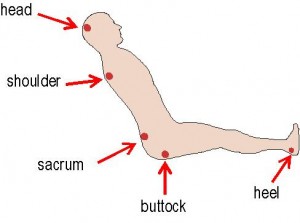 Bed sores result from prolonged pressure that prevents proper blood flow to tissues, which, in turn, kills that tissue. The death of this tissue most often occurs when it is compressed between a bony prominence and an external surface, i.e. bed, wheelchair, or sometimes even other parts of the body. Some of the worst bed sores that occur in nursing home patients don’t even occur from those that are bed ridden as the name suggests. Prolonged sitting in a wheelchair can lead to bed sore development. It is important that nursing home staff members are equally vigilant with their nursing home patients in wheelchairs and in beds.
 These surfaces typically have layers that help provide optimal immersion and comfort for the nursing home patient. These surfaces are designed to have independent zones to provide the correct pressure for each weight range. These surfaces are designed, in fact, to help aid in both the prevention and the treatment of bed sores and pressure ulcers. Redistribution of surface pressue is very important as the pressure causes the small blood vessels in the skin to collapse, which deprives the skin of oxygen and nutrients, causing them to die. Nursing homes should avoid using donut-type devices and most sheepskin products for pressure redistribution. Staff members should be aware of the need for proper surfaces. Not using the proper surface for patients is tantamount to nursing home abuse. The use of the proper pressure-redistributing surfaces along with proper repositioning may be two of the most important bed sore prevention tips that all families should be aware of and vigilant to for the well being of their loved ones.