Today we continue our posts exposing some of the more below average nursing homes in New Jersey. As nursing home abuse lawyers, it is important that we are aware of such nursing homes and, as expert attorneys in this field, should expose long term patient centers with high numbers of deficiencies.
According to Medicare’s Nursing Home Compare system, a Medicare website feature that you can use to compare nursing homes across the United States, the average New Jersey nursing home will be cited with approximately 12 deficiencies in a 2 year period of inspections. The nursing home we will discuss today, Oceanview Center for Rehabilitation, was cited with 21 deficiencies in 2 years of routine inspections. It is a for profit center with 120 long term care beds located in Cape May County.
Oceanview Center Well Below Average
 This for-profit, corporately owned nursing home was cited for a variety of deficiencies from November 2008 through October 2010. The citations were in a wide variety of categories including, among others, nutrition/dietary needs, living environment, and pharmaceutical responsibilities. For example, it indicated that some residents were affected by the fact that the pharmacy made medication errors of more than 5%. These errors are defined as administering the wrong drugs, administering the wrong doses, or administering drugs ate the wrong times. Medication errors can lead to many serious health issues.
Oceanview was also cited for housekeeping an maintenance issues that affected many of the patients. The facility was even cited for issues regarding patient dignity and respect. Oceanview Center for Rehab was given twice as many citations as the average nursing home in New Jersey and, in fact, was only rated with one out of five stars in the Medicare report. This rating is considered to be significantly below average. This rating should make prospective residents a bit weary of the care they would receive while residing at this facility.
Nursing Home Abuse Attorneys in New Jersey and Philadelphia
If your loved on is a resident at a nursing home or long term care facility, and you believe that the care they are receiving is poor, negligent, or abusive, contact the Mininno Law Office for free case evaluation, or call for a free consultation at (856) 833-0600 in New Jersey, or (215) 567-2380 in Philadelphia.
Let the team at the Mininno Law Office earn you the compensation you need and deserve.
 The Lincoln Specialty Care Center has had 2 routine inspections between November 2008 and October 2010. During this time period, the facility had 57 cited deficiencies. At an average of 25 deficiencies per visit, the Lincoln Specialty Care Center acquired almost double the amount of citations that some of the other troublesome nursing homes we’ve discussed have acquired.
 Silver Care Health Center has had two routine inspections in the two year period from November 2008 through October 2010. During those two routine inspections, the Silver Care Health Care Center was cited for 31 deficiencies. The Silver Care nursing home was cited for numerous violations, i.e. life safety code standard violations, housekeeping, drug regimen not being free of unnecessary drugs, and life safety from fire issues. A number of these deficiencies were considered widespread and able to cause more than minimal harm.
  Today we are posting on Sterling Manor. Sterling Manor is a nursing home that has 124 long term patient beds under its care. It is located in Maple Shade, New Jersey in Burlington County. Sterling Manor had 3 routine inspections over the two year period from November 2008 until October 2010. It also had 14 complaint inspections during that same time period. The Sterling Manor nursing home was cited for physician visit issues relating to care/notes/orders etc., as well as residential record issues, life safety code violations, and bed sores. (As we have posted on many occasions, bed sores, themselves, are signs or nursing home abuse.)
 Today’s post takes a look at a nursing home facility in Gloucester County. The name of the facility is Manorcare Health Services. It is located on West Deptford and has 156 long term care beds.
  Today we are reporting about the South Jersey Health Care Center located in Camden, New Jersey. This is a nursing home that has 120 long term care patient beds. In a two year period, from November 2008 until October 2010, this nursing home was inspected on two separate occasions. During those inspections, the nursing home was cited for 16 separate violations. These violations included failure to meet proper safety code standards, lack of proper housekeeping and maintenance services, and food and nutritional issues. Many of the violations were found to occur often, and at least one of the violations was considered immediate jeopardy to residents’ health and safety.
 As a family member of a nursing home resident, it is important to be aware of the signs and symptoms of nursing home neglect and abuse. Keep a close watch not only on your loved one, but on the facility in it’s entirety, for the following signs of neglect:
 It is important that nursing home staff be fully trained in how to deal with the special needs of nursing home patients so that physical abuse does not occur. It is also important that a patient’s family be aware of the signs of abuse. Some of the more obvious signs are bruising, cuts, unexplained marks, broken bones, and a variety of injuries in various stages of healing. It is also important to listen to the patient. A resident’s report of violent behavior, such as being hit or mistreated, must be investigated. Sometimes, a nursing home patient’s sudden change in behavior can be a sign of nursing home abuse or neglect and should absolutely be investigated.
  One way to prevent bed sores from forming is to have a staff that is properly educated. Educational programs about bed sore and pressure ulcer prevention should be made mandatory for all levels of health care providers. They should also be made available for patient families so that they can make sure nursing home staff members are giving their loved ones the care they need and deserve. Patients who have the appropriate mental capacity should also be given instructions so that they can be advocates for their own proper care.
 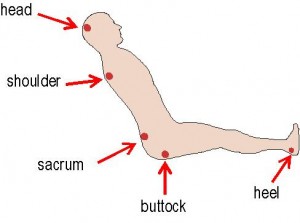 Bed sores result from prolonged pressure that prevents proper blood flow to tissues, which, in turn, kills that tissue. The death of this tissue most often occurs when it is compressed between a bony prominence and an external surface, i.e. bed, wheelchair, or sometimes even other parts of the body. Some of the worst bed sores that occur in nursing home patients don’t even occur from those that are bed ridden as the name suggests. Prolonged sitting in a wheelchair can lead to bed sore development. It is important that nursing home staff members are equally vigilant with their nursing home patients in wheelchairs and in beds.